The impact of VAR on penalties and match outcomes
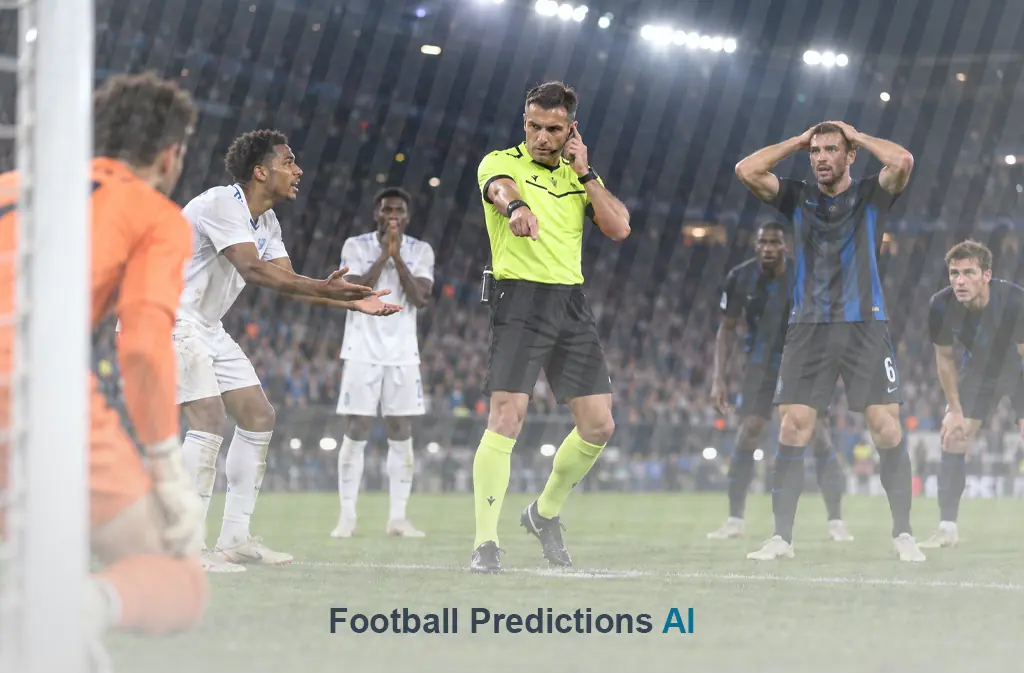
Why VAR changed the way matches are decided
VAR has changed modern football because it does not simply correct obvious mistakes. It changes the rhythm of decision-making, the probability of penalties being awarded, the way goals are reviewed, and the emotional flow of a match. Before video review, many key incidents were decided instantly by the referee and assistants. Now, the most decisive moments can be paused, checked, reviewed, and sometimes reversed after the initial reaction inside the stadium.
For football predictions, this matters because penalties and overturned goals are not minor details. They are high-impact events. A single penalty can transform a low-scoring match, alter the tactical balance, and change the behaviour of both teams for the rest of the game. A goal that is ruled out after review can have the same effect in reverse: it removes the scoreboard change but still leaves a psychological and tactical mark on the match.
The biggest mistake is to see VAR as only a refereeing topic. It is also a forecasting topic. If your model tries to estimate goals, win probability, live momentum, or match volatility, VAR has to be part of the discussion because it directly affects the incidents most likely to move those probabilities.
How VAR affects penalty decisions
Penalties are one of the clearest areas where VAR has had a major influence. The reason is simple: penalty-area incidents are often crowded, fast, and difficult to judge from one angle. A shirt pull, a late foot, a handball, or a small trip may be missed in real time but become visible through replay. Once VAR is available, these moments are more likely to be checked and, in some cases, corrected.
VAR does not mean every contact becomes a penalty. The protocol is built around specific match-changing incidents, including penalty and no-penalty decisions. The system is intended to intervene when there is a clear and obvious error or a serious missed incident, not to re-referee every moment in the box. That distinction is important because the existence of VAR increases scrutiny, but it does not remove subjectivity from football.
Why more reviewable incidents change the risk profile
From a prediction point of view, the main issue is not whether VAR “helps” or “hurts” a particular team. The key issue is that penalty probability becomes more sensitive to penalty-box behaviour. Teams that defend deep, allow many box entries, or rely on last-second tackles may carry higher VAR exposure because more of their defensive actions happen in reviewable areas. By contrast, teams that prevent box access may face fewer high-risk review situations.
This does not mean a model should blindly increase penalty expectations in every VAR competition. It means that penalty likelihood should be linked to the type and volume of penalty-area events: touches in the box, dribbles into the area, crosses under pressure, sliding challenges, blocked shots, and handball exposure. VAR makes those events more consequential because missed incidents have a higher chance of being revisited.
Handball and contact decisions remain difficult
Even with replay, penalty decisions are not always simple. Handball interpretations can depend on arm position, body movement, proximity, deflection, and whether the arm makes the body unnaturally bigger. Contact decisions can depend on whether the challenge caused the attacker to fall, whether the attacker initiated contact, and whether the defender played the ball first. VAR can improve access to evidence, but it cannot eliminate judgment.
That is why penalties remain noisy in prediction models. A good model can estimate risk; it cannot predict the exact review decision in a single match. The professional approach is to treat VAR as a factor that changes the distribution of possible outcomes, not as a guarantee of accuracy or consistency.
Why penalties matter so much for match outcomes
Football is low scoring. That is the entire reason penalties have such large influence. In a sport where many matches are decided by 1 goal, a penalty can be the difference between a draw and a win, or between a controlled match and a chaotic comeback. A penalty also changes the state of the game instantly, and game state changes tactics.
If a team scores from a penalty early, it may reduce risk, defend deeper, and force the opponent to chase. If a team misses a penalty, it may lose momentum and become more exposed emotionally. If a late penalty is awarded, it can decide the result before either side has time to adjust. For forecasting, all of these effects matter because the original pre-match expectation may no longer describe the match that is actually unfolding.
Penalty conversion and expected goals
Penalties carry a high expected-goal value compared with normal shots. That means a match with a penalty can quickly exceed its expected goal total even if open-play chance creation was modest. This is why totals markets and live goal models need to separate open-play quality from penalty events. A match can be tactically closed and still produce 2 or 3 goals if penalties or VAR-reviewed incidents intervene.
For pre-match models, the important question is not only “which team is better?” but also “which team is more likely to generate penalty-box pressure?” Teams that carry the ball into the box, attack 1v1, and force desperate defensive actions may create more penalty risk than teams that mainly shoot from distance.
VAR and the changing meaning of game state
Game state is one of the most important concepts in football prediction. Teams behave differently at 0-0 than they do when leading 1-0 or trailing 2-1. VAR complicates game state because it can temporarily suspend certainty. A goal may appear to put a team ahead, but the match is not truly in that state until the review is complete. A penalty appeal may create pressure before any decision is made. A red-card check may shift player behaviour even before the final call.
This matters especially for live betting and in-game forecasting. Models that update immediately after an apparent goal, without accounting for review probability, can move too aggressively. Likewise, models that ignore a possible penalty check may lag behind the true risk. The best live systems need a review-aware layer: not only what happened, but whether that event is stable, under check, or vulnerable to reversal.
Momentum after a review
VAR reviews can also interrupt momentum. A team attacking with intensity may lose rhythm during a long check. A defending team may use the pause to reset emotionally and tactically. A crowd can shift from celebration to frustration, or from anger to energy, depending on the final decision. These effects are difficult to quantify, but they are real enough to matter in live interpretation.
For predictive models, the safest way to handle this is not to invent a “momentum emotion” variable without evidence. It is to monitor measurable consequences after reviews: shot rate, possession territory, pressing intensity, fouls, cards, and substitution timing. If review interruptions consistently affect those signals in certain leagues or teams, the model can learn from them.
Where VAR fits into league-level football predictions
VAR does not operate in a vacuum. Different leagues have different refereeing cultures, review thresholds, camera setups, and communication standards. That means VAR impact is not identical everywhere. Some competitions may produce more intervention, while others may maintain a higher threshold for overturning on-field decisions.
When building predictions across many competitions, it is useful to compare league patterns rather than assuming one global VAR effect. For broader league coverage and match-by-match context, you can explore football predictions for all top leagues, where league differences matter because pace, refereeing style, and penalty frequency can vary significantly from one competition to another.
League style changes VAR exposure
A high-tempo league with aggressive pressing and frequent box entries may naturally generate more reviewable incidents. A slower, more possession-heavy league may produce fewer chaotic penalty-area actions, but more marginal offside and handball debates around structured attacks. A physical league may create more contact situations, while a technical league may create more dribbles and last-second defensive challenges.
This is why league-specific modelling matters. If you build one global penalty expectation and apply it everywhere, you risk missing the interaction between refereeing culture, tactical style, and VAR usage. Better models estimate penalty and review risk within the context of each league.
How VAR affects goals, offsides, and disallowed outcomes
Penalties get the most attention, but VAR also affects match outcomes through goal reviews. A goal can be checked for offside, foul in the attacking phase, handball, or ball out of play. This means some goals that would previously have stood are now removed, while some missed offences can be corrected before the restart.
The effect is not simply “more goals” or “fewer goals.” VAR can add penalties, which increases scoring probability, but it can also disallow goals, which reduces it. The net effect depends on the competition, the technology used, and the type of incidents common in that league.
Marginal offsides and attacking behaviour
Offside reviews have changed the way some goals are experienced. A tight run behind the defensive line can produce a goal, a celebration, a pause, and then a reversal. For models, offside reviews matter because high-line teams create more situations where attackers run on the shoulder of the last defender. These tactical choices can increase both chance creation and disallowed-goal risk.
That does not mean teams should avoid attacking space. It means the probability distribution becomes more complex. A high-line, high-transition match may have more chances, more goals, and more reviews. AI models should learn the full pattern rather than only counting final goals.
VAR protocol and why the referee still matters
The Laws of the Game define VAR as a system for specific match-changing situations, including goals, penalty decisions, direct red cards, and mistaken identity. The referee remains the final decision-maker, and the VAR is there to assist when the evidence suggests a review is required. This is why two similar incidents can still lead to different outcomes: the threshold for intervention and the referee’s interpretation both matter.
For readers who want a deeper explanation of the VAR process and how it is expected to work in major tournaments, this VAR explained by a former referee feature is a useful reference for understanding the practical review framework.
Clear and obvious does not mean simple
The phrase “clear and obvious” sounds straightforward, but in practice it still depends on interpretation. A factual offside line is different from a judgement call on contact. A goalkeeper encroachment decision is different from a handball decision. Some incidents are binary; others sit in the grey area where replay shows more detail but does not remove debate.
For football prediction, this is an important reminder: referee and VAR behaviour are part of uncertainty. You can model tendencies, but you cannot treat them as mechanical rules. A strong model estimates probabilities, not certainties.
How AI can model VAR impact
AI can help because VAR impact is not random in the broad sense. It is linked to events that can be measured. The best approach is to build features around the behaviours that lead to reviews and penalties, then evaluate how those features perform across leagues and seasons.
Penalty-area pressure
Useful features include touches in the box, carries into the penalty area, dribbles completed in dangerous zones, cutbacks, crosses under pressure, and shots blocked at close range. These actions increase the number of moments where a defender may mistime a challenge or handle the ball.
Defensive desperation signals
Teams that concede many box entries and defend with emergency actions may create more penalty risk. Sliding tackles, last-man challenges, blocked shots from close distance, and repeated recovery defending are signals that the defensive structure is under stress. VAR makes these moments more important because missed offences can be checked.
Referee and competition tendencies
Some referees are more likely to give penalties, show cards, or accept VAR intervention. Some competitions apply review thresholds more strictly. AI models can include referee-level and competition-level effects, but the sample size must be handled carefully. Overreacting to small referee samples is a common modelling mistake.
What bettors and analysts should do with VAR information
VAR information should not be used as a lazy excuse after a match. It should be used to improve pre-match and live evaluation. If a team regularly creates penalty-box pressure, that should be priced differently from a team that dominates possession without entering dangerous areas. If a league has a higher penalty rate or more strict handball interpretation, that can affect totals, both teams to score, and match outcome probabilities.
For live analysis, the key is to update carefully. A penalty review should move probabilities, but the size of the move depends on whether the decision is confirmed, overturned, or still uncertain. A disallowed goal should reset the scoreline, but not completely erase the information that the attacking team created a dangerous sequence.
Avoid overreacting to single incidents
One controversial review does not prove a trend. Serious forecasting needs samples, context, and calibration. If you change your entire model because of one dramatic VAR decision, you are not analysing; you are reacting. The correct response is to log the incident, categorize it, and see whether similar incidents form a pattern over time.
The bottom line: VAR increases the value of context
VAR has made football more reviewable, but not perfectly predictable. It has increased the importance of penalty-area behaviour, game-state awareness, referee tendencies, and league-specific interpretation. Penalties and overturned goals can swing match outcomes dramatically, which means models that ignore VAR-related dynamics are missing an important layer of modern football.
The smartest approach is not to assume VAR always creates more goals, more penalties, or more fairness. The smartest approach is to measure how VAR changes the probability of match-changing incidents and to build that evidence into forecasting. In modern football, the question is not only who is better. It is also who creates the moments that force the referee, the video room, and the match itself to change direction.