Value betting explained with examples from AI probabilities
Value betting is not about winners, it is about prices
Most people describe betting as “picking who wins.” That framing is emotionally satisfying, but it is not how professional betting works. Professionals treat betting as a pricing problem. The outcome of a football match is uncertain, but the odds offer a specific price for that uncertainty. Value betting is the practice of consistently buying outcomes when the price is too high relative to your best estimate of probability, and avoiding outcomes when the price is too low.
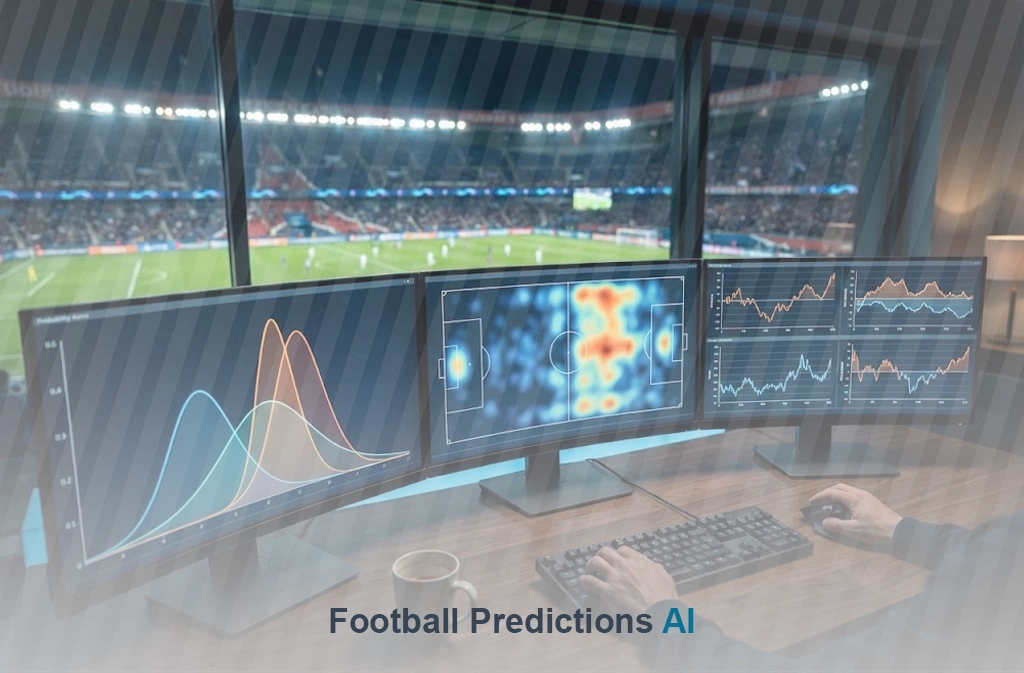
AI probabilities are useful because they force you to turn opinions into numbers. When you express your belief as a probability, you can compare it to the market, quantify the edge, and measure performance honestly over time. That is the real advantage of AI in this context. It removes improvisation and replaces it with a repeatable decision rule.
The key idea is simple: you do not need to win “today.” You need to place bets that would be profitable if you could repeat the same decision hundreds or thousands of times. Football variance is brutal in small samples. Value betting is designed for the long run.
What “value” means in 1 line
A bet has value when your estimated probability is higher than the implied probability in the odds.
Step 1: convert odds into implied probability
You cannot talk about value without converting odds into probabilities. With decimal odds, the implied probability is 1 divided by the odds. That is the market’s probability estimate before you account for bookmaker margin.
Example conversions: odds 2.00 implies 50% (1 / 2.00). Odds 1.80 implies 55.56% (1 / 1.80). Odds 3.20 implies 31.25% (1 / 3.20). This conversion is the starting point for every value decision.
Why margin matters and when you should remove it
Bookmakers build margin into prices, so the implied probabilities of all outcomes typically sum to more than 100%. If you compare your model probabilities to raw implied probabilities across many matches, you will often underestimate how hard it is to have true edge, because some of your “edge” is simply the bookmaker’s margin.
In practice, there are 2 reasonable approaches. If you are doing quick manual decisions, you can compare directly and use a higher edge threshold to compensate. If you are building an AI-driven system and want professional evaluation, you should remove margin so you compare your probabilities against a cleaner market estimate.
A practical margin removal approach for 1x2 markets
For a 1x2 market, convert each outcome’s odds into implied probabilities, sum them, and divide each probability by the sum. This normalizes the probabilities back to 100%. It is not perfect, but it is a practical way to make market probabilities comparable across bookmakers and matches.
Step 2: expected value is the math behind “value”
Value is not a vibe. It is expected value, often written as EV. EV is the average outcome you would expect if you repeated the same bet many times. In decimal odds, a useful EV expression for a 1-unit stake is:
EV = (p × odds) - 1
Where p is your estimated probability and odds is the decimal price. If EV is greater than 0, the bet is positive expected value. If it is less than 0, you are paying too much for the probability you are receiving.
Example 1: a clean value bet
Your AI model estimates Team A has a 56% chance to win. The bookmaker offers odds of 2.05. The implied probability is 48.78% (1 / 2.05). Your estimate is higher than the market’s price suggests.
EV = (0.56 × 2.05) - 1 = 1.148 - 1 = 0.148. That is +14.8% expected value per unit staked, assuming your 56% estimate is accurate and well calibrated. It does not guarantee the next match. It implies profitability over repetition.
Example 2: “I like it” is not value
Your model estimates Team B at 34% to win. Odds are 2.90. Implied probability is 34.48% (1 / 2.90). That is basically the same. You can still bet, but it is not value. Any long-term profit would rely on luck, not edge.
EV = (0.34 × 2.90) - 1 = 0.986 - 1 = -0.014. Slightly negative. This is exactly how many bettors lose slowly while occasionally feeling brilliant.
AI probabilities: what they do well and what they cannot do
AI models are excellent at consistency, scale, and avoiding emotional weighting errors. They are not automatically good at truth. A model can be confident and wrong. The edge of AI comes from disciplined probability estimation and continuous evaluation, not from being “smart.”
Calibration is non-negotiable
If your model says “60%” often, those selections should win roughly 60% of the time over a large sample. That is calibration. Without calibration, value betting collapses because your edge numbers are fiction. Many models look accurate in backtests but fail in live performance because they were trained with leakage, overfit to specific seasons, or evaluated on biased samples.
Why probabilities beat picks
Picks encourage certainty theatre. Probabilities encourage decision quality. This is why probability-first prediction platforms are more useful than tip lists: you can compare probabilities to odds, compute EV, and track performance objectively. If you want a reference point for how probability-driven predictions are presented in a clean format, see football predictions AI, where the focus is on probabilities and match context rather than only “who wins.”
How to spot value professionally, not emotionally
Professional value betting is a workflow. The goal is to make the same kind of decision every day, with the same logic, and then audit results honestly.
Step 1: lock the prediction timestamp
Decide when your prediction exists: 48 hours before kickoff, 24 hours, 2 hours, or after lineups. This matters because odds move and information changes. If your model uses late information but you bet early, your edge will be inconsistent and your evaluation will be dishonest.
Step 2: build a market probability baseline
Capture odds from one bookmaker or, better, an average of several. Convert to implied probabilities and, if you are serious, normalize for margin. This creates the market baseline you compare to.
Step 3: compute edge and EV
Edge = p_model - p_market. EV = (p_model × odds) - 1. Use both. Edge helps you filter. EV tells you what the edge is worth at the given price. The same edge can be more or less valuable depending on odds.
Step 4: apply an error margin to your own model
Professional bettors assume their probabilities are noisy. They require a buffer, not a tiny gap. Many systems use thresholds such as 2% to 5% edge minimum in liquid markets, and higher thresholds in lower leagues where model error is larger and odds can be less efficient. This is not superstition. It is risk control.
Step 5: sanity-check why you differ from the market
If your model is far from the market, ask why. Are you missing team news? Are odds reacting to a lineup leak? Is your model overreacting to recent results or a finishing streak? Some of the biggest losing periods in value betting come from ignoring this step and blindly treating “big disagreement” as “big value.”
Examples across football markets using AI probabilities
Value betting logic works across markets as long as you can estimate probabilities. The challenge is that some markets are more volatile and more sensitive to late information.
1x2 example: away win
Your AI gives the away team a 38% win probability. Odds are 3.10, implying 32.26%. EV = (0.38 × 3.10) - 1 = 1.178 - 1 = 0.178. This is strong on paper, but you should ask whether the market is pricing in injury news or a rotation expectation your model has not captured. If your model is stable and your inputs are clean, this can be exactly the type of uncomfortable value that produces long-term profit.
Over and under goals example: over 2.5
Your model estimates over 2.5 goals at 57%. Odds are 2.02, implying 49.50%. EV = (0.57 × 2.02) - 1 = 1.1514 - 1 = 0.1514. Totals markets react sharply to lineup quality, goalkeeper changes, and tactical incentive shifts. If your prediction timestamp is early, you may want a larger edge threshold.
Both teams to score example
Your model puts BTTS at 60%. Odds are 1.95, implying 51.28%. EV = (0.60 × 1.95) - 1 = 1.17 - 1 = 0.17. This looks like value, but BTTS is sensitive to match incentives. A team that benefits from a draw or is protecting a lead from a previous leg can suppress scoring even when the underlying attack metrics look strong. This is where model context features matter.
Closing line value: how professionals judge themselves
Many serious bettors track closing line value, usually shortened to CLV. The idea is that the closing price is often the most efficient market price because it includes more information and more liquidity. If you regularly beat the closing line, it suggests you are consistently getting better prices than the market ultimately settled on.
CLV is not the same as profit. You can beat the closing line and still lose short-term due to variance. But over large samples, positive CLV is a strong indicator your process is finding value, especially in liquid markets.
How AI helps with CLV
AI does not magically create CLV. It helps you detect mispricing earlier by applying consistent evaluation across many matches. It also helps you avoid emotional bets that feel good but are priced badly. Over time, a probability-first workflow tends to produce better price discipline, which is the foundation of CLV.
Staking: value without bankroll control is still failure
Even strong value betting has losing streaks. Stake sizing determines whether you survive them. A common professional approach is fractional Kelly staking, which scales stake size to your edge and odds while reducing volatility compared to full Kelly. If you do not want complexity, fixed staking with strict limits is acceptable, but you must be consistent.
Why stake sizing matters more in football
Football’s low scoring increases variance. That means even a good model can lose repeatedly in the short term. Overbetting a perceived edge can ruin a bankroll before the edge has time to show itself. A professional process assumes variance and sizes bets so the bankroll can absorb it.
Common traps that make “value betting” unprofitable
Overconfidence in a noisy probability estimate
Your model is not perfect. If you treat small edges as real, you will churn money into margin. This is why thresholds and error buffers exist. If your model error is ±4% in a league, a claimed 2% edge is not edge, it is noise.
Leakage and dishonest backtests
Many AI betting models quietly use information that was not available at prediction time, such as closing odds or confirmed lineups. The backtest looks impressive, then performance collapses live. The fix is timestamp discipline: store feature snapshots and train per prediction horizon.
Ignoring market type differences
A model that works for 1x2 may not work for corners or cards without specialised features and validation. Value betting is not “one model fits all.” Each market has its own drivers, liquidity, and noise profile.
The bottom line: value betting is an auditable system
Value betting is simple in concept and demanding in execution. You need probabilities you can justify, prices captured at the right time, a clear edge threshold, and staking rules that keep you alive through variance. AI probabilities are powerful because they turn intuition into measurable estimates and make your process repeatable, but they only help if you track calibration, avoid leakage, and evaluate honestly against the market.
If you can do that, you are no longer betting on feelings. You are running a decision system where each bet has a measurable rationale, and the long-term result is driven by probability discipline rather than narrative.